Avoid getting into a mindset that resists change, fill the administrative system with energy of New India: PM to IAS officers
Boldness is required to drive change: PM Modi to IAS officers
Dynamic change is needed to transform the system: PM Modi to IAS officers
The Prime Minister, Shri Narendra Modi, today advised young IAS officers to avoid getting into a mindset that resists change, and fill India’s administrative system with the energy of ‘New India.’
Addressing IAS Officers of the 2015 batch at the Inaugural Session of Assistant Secretaries, the Prime Minister began by asserting that India has not progressed as much as it should have. He said countries that achieved independence after India, and faced greater resource constraints than India, have touched new heights of development. He said boldness is required to drive change, and added that a fragmented administrative arrangement does not allow the collective capabilities of officers to deliver to the optimum level. He said dynamic change is needed to transform the system.
He said that this three month programme of Assistant Secretaries, is now into its third year, and would have a great impact. He urged the young officers to interact freely with the senior-most officers of the Union Government over the next three months, so that the system could benefit from the combination of their energy and fresh ideas, and the administrative experience of Secretary-level officers.
The Prime Minister asked the young officers to recall their life upto the day of the UPSC result, the challenges they faced; and use the opportunities they will now have, to bring about positive changes in the system, and the lives of the common people.
The Union Minister of State for Personnel, Public Grievances and Pensions, Dr. Jitendra Singh and senior Government Officers were present on the occasion.
Cabinet approves three new corridors as part of Delhi Metro’s Phase V (A) Project
December 24, 2025
Share
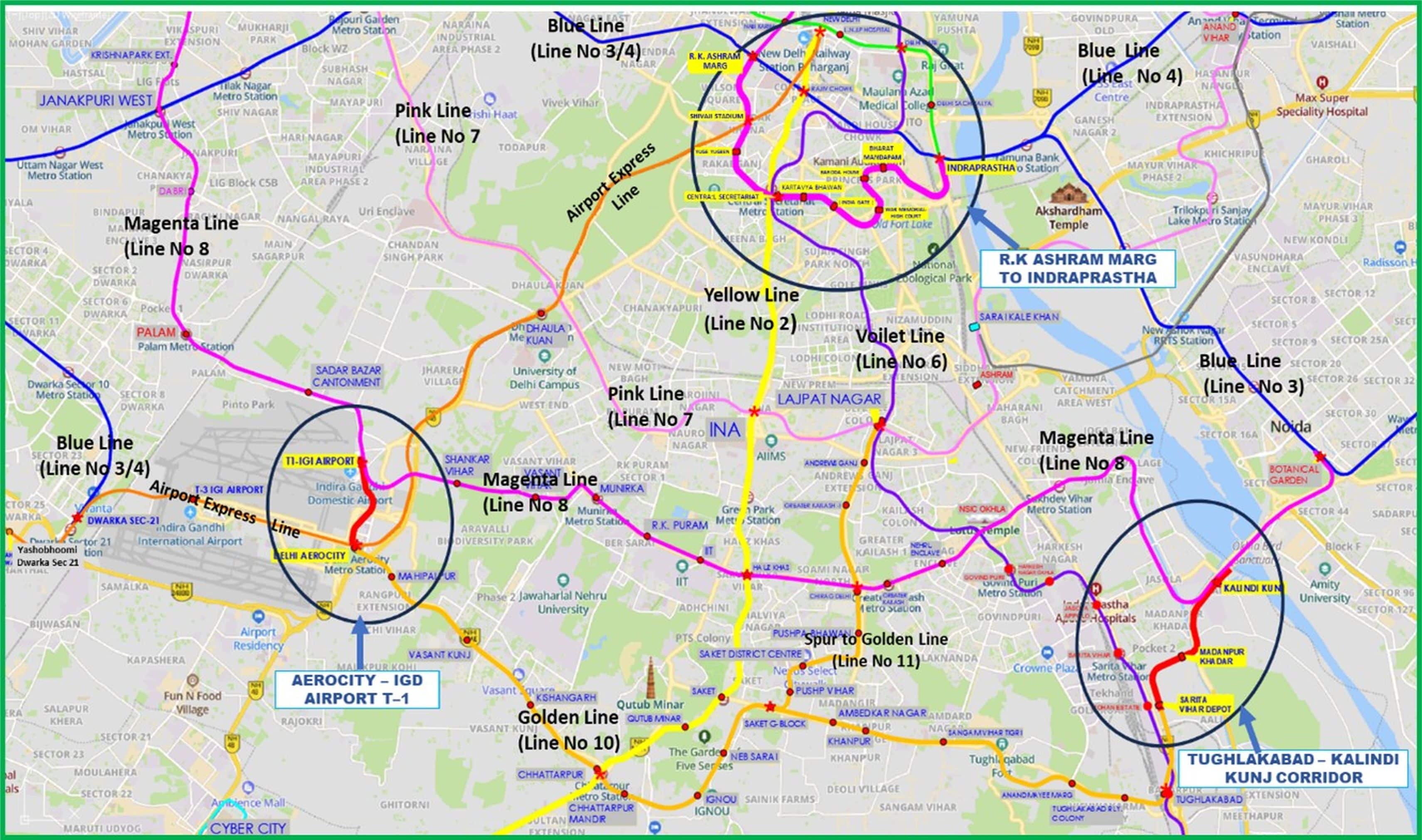
The Union Cabinet chaired by the Prime Minister, Shri Narendra Modi has approved three new corridors - 1. R.K Ashram Marg to Indraprastha (9.913 Kms), 2. Aerocity to IGD Airport T-1 (2.263 kms) 3. Tughlakabad to Kalindi Kunj (3.9 kms) as part of Delhi Metro’s Phase – V(A) project consisting of 16.076 kms which will further enhance connectivity within the national capital. Total project cost of Delhi Metro’s Phase – V(A) project is Rs.12014.91 crore, which will be sourced from Government of India, Government of Delhi, and international funding agencies.
The Central Vista corridor will provide connectivity to all the Kartavya Bhawans thereby providing door step connectivity to the office goers and visitors in this area. With this connectivity around 60,000 office goers and 2 lakh visitors will get benefitted on daily basis. These corridors will further reduce pollution and usage of fossil fuels enhancing ease of living.
Details:
The RK Ashram Marg – Indraprastha section will be an extension of the Botanical Garden-R.K. Ashram Marg corridor. It will provide Metro connectivity to the Central Vista area, which is currently under redevelopment. The Aerocity – IGD Airport Terminal 1 and Tughlakabad – Kalindi Kunj sections will be an extension of the Aerocity-Tughlakabad corridor and will boost connectivity of the airport with the southern parts of the national capital in areas such as Tughlakabad, Saket, Kalindi Kunj etc. These extensions will comprise of 13 stations. Out of these 10 stations will be underground and 03 stations will be elevated.
After completion, the corridor-1 namely R.K Ashram Marg to Indraprastha (9.913 Kms), will improve the connectivity of West, North and old Delhi with Central Delhi and the other two corridors namely Aerocity to IGD Airport T-1 (2.263 kms) and Tughlakabad to Kalindi Kunj (3.9 kms) corridors will connect south Delhi with the domestic Airport Terminal-1 via Saket, Chattarpur etc which will tremendously boost connectivity within National Capital.
These metro extensions of the Phase – V (A) project will expand the reach of Delhi Metro network in Central Delhi and Domestic Airport thereby further boosting the economy. These extensions of the Magenta Line and Golden Line will reduce congestion on the roads; thus, will help in reducing the pollution caused by motor vehicles.
The stations, which shall come up on the RK Ashram Marg - Indraprastha section are: R.K Ashram Marg, Shivaji Stadium, Central Secretariat, Kartavya Bhawan, India Gate, War Memorial - High Court, Baroda House, Bharat Mandapam, and Indraprastha.
The stations on the Tughlakabad – Kalindi Kunj section will be Sarita Vihar Depot, Madanpur Khadar, and Kalindi Kunj, while the Aerocity station will be connected further with the IGD T-1 station.
Construction of Phase-IV consisting of 111 km and 83 stations are underway, and as of today, about 80.43% of civil construction of Phase-IV (3 Priority) corridors has been completed. The Phase-IV (3 Priority) corridors are likely to be completed in stages by December 2026.
Today, the Delhi Metro caters to an average of 65 lakh passenger journeys per day. The maximum passenger journey recorded so far is 81.87 lakh on August 08, 2025. Delhi Metro has become the lifeline of the city by setting the epitome of excellence in the core parameters of MRTS, i.e. punctuality, reliability, and safety.
A total of 12 metro lines of about 395 km with 289 stations are being operated by DMRC in Delhi and NCR at present. Today, Delhi Metro has the largest Metro network in India and is also one of the largest Metros in the world.