Joint Vision Statement on India - Bhutan Energy Partnership

Published By : Admin | March 22, 2024 | 17:20 IST

India and Bhutan share an exemplary bilateral relationship characterized by trust, goodwill and mutual understanding at all levels, strong bonds of friendship and close people-to-people contacts. Prime Minister Shri Narendra Modi and Prime Minister Dasho Tshering Tobgay had fruitful and wide ranging discussions in Thimphu wherein the two leaders reaffirmed their commitment to taking this extraordinary bilateral partnership to new heights, looking into the future.

The two leaders noted the stellar contribution of clean energy partnership in the development of hydro-power sector of Bhutan, and in providing energy security to the region. Prime Minister Modi appreciated growing domestic capacity of Bhutanese firms and technical agencies in implementation of energy projects. Prime Minister Tobgay congratulated Prime Minister Modi for the remarkable growth of India’s renewable energy sector in recent years, and for his leadership in fostering initiatives such as International Solar Alliance and National Green Hydrogen Mission of India.

Both the Prime Ministers reviewed all aspects of bilateral energy cooperation and expressed satisfaction that projects, which have been jointly implemented, are functioning well and contributing to economic development in Bhutan. Building on the success of the 720 MW Mangdechhu Hydro-electric Project, the two leaders look forward to commissioning the 1020 MW Punatsangchhu-II Hydro-electric Project this year. Both sides welcomed the positive expert-level discussions on a technically sound and cost – effective way forward for 1200 MW Punatsangchhu – I HEP.

4. Both the Prime Ministers agreed

(i) That the India-Bhutan energy partnership has the potential to benefit both the countries by enhancing energy security, strengthening their economies, generating employment, enhancing export earnings, and contributing to further development of industrial and financial capacities.

(ii) That there are unprecedented opportunities to further strengthening this mutually beneficial bilateral clean energy partnership, including through development of new energy projects and trade in electricity.

(iii) To engage in the development of new energy projects in the fields of hydro-power, solar and green hydrogen, including through the participation of Indian entities as strategic partners.

(iv) That both Governments will review and finalize project - specific implementation modalities for new projects, including reservoir hydro projects.

(v) That the Government of India will facilitate necessary access to financing from financial institutions in India as well as market for power sale for new and upcoming hydro-power projects in Bhutan.

(vi) Power exchange between the two countries shall continue to play an important role in ensuring energy security in the region. In this regard, market access to Bhutanese power producers will be facilitated in accordance with applicable domestic regulations and procedures, through mutually agreed arrangements and delivery points.

(vii) In view of the evolving energy markets, to hold regular consultations for enabling investments in energy projects of Bhutan, and for ensuring seamless cross-border trade in electricity.

(viii) To work towards greater sub-regional energy cooperation, which would lead to increased inter-linkages between the economies for mutual benefit of all stakeholders.

(ix) To strengthen energy cooperation in the field of energy efficiency and energy conservation through capacity development, information exchange on policies and technologies, and research and development on energy efficient technologies.

Both the Prime Ministers agreed to expedite movement on projects and initiatives on the basis of the Joint Vision Statement for mutual benefit.

Explore More
Today, the entire country and entire world is filled with the spirit of Bhagwan Shri Ram: PM Modi at Dhwajarohan Utsav in Ayodhya

பிரபலமான பேச்சுகள்

Today, the entire country and entire world is filled with the spirit of Bhagwan Shri Ram: PM Modi at Dhwajarohan Utsav in Ayodhya
Regional languages take precedence in Lok Sabha addresses

Media Coverage

Regional languages take precedence in Lok Sabha addresses
NM on the go

Nm on the go

Always be the first to hear from the PM. Get the App Now!
...
Cabinet approves three new corridors as part of Delhi Metro’s Phase V (A) Project
December 24, 2025

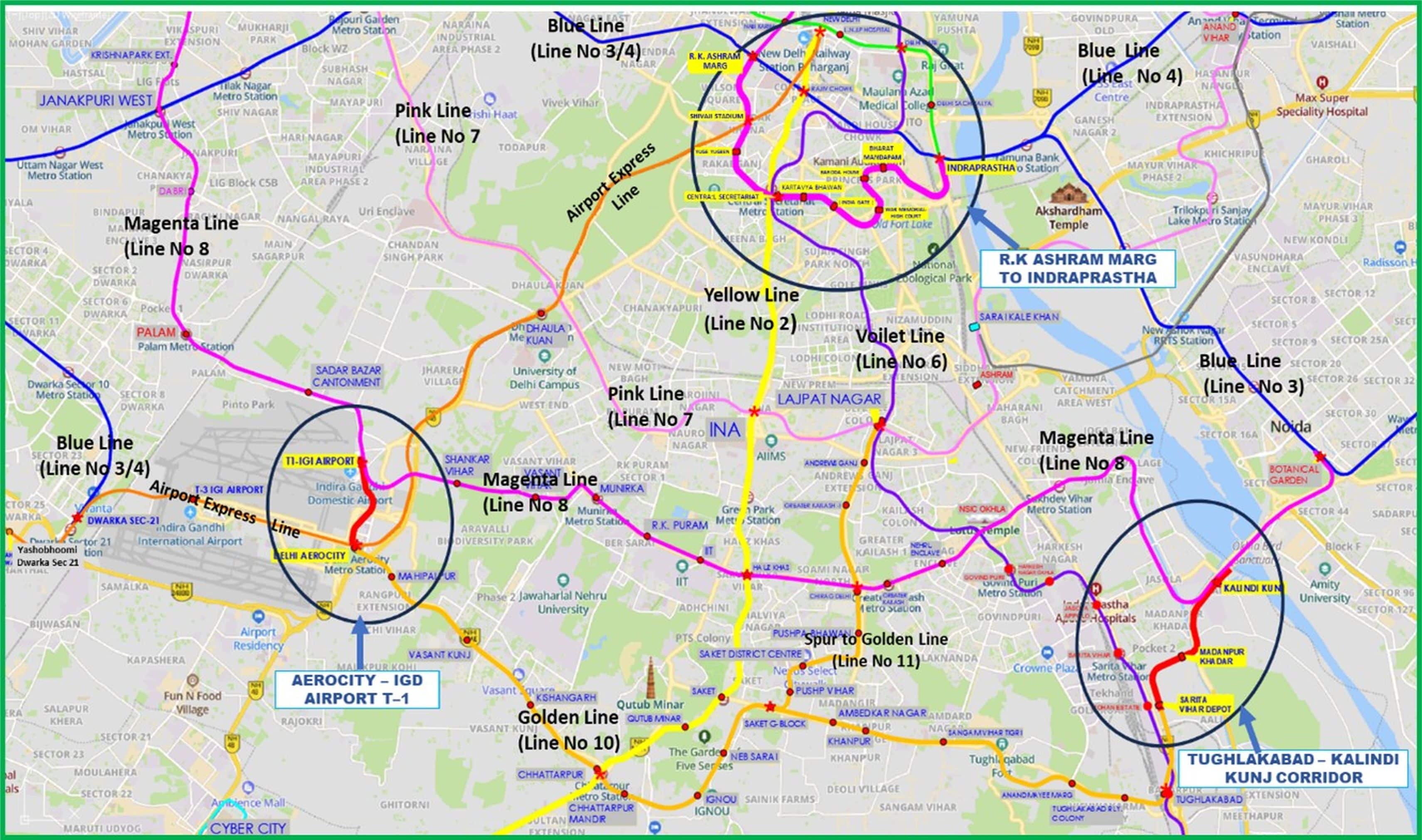
The Union Cabinet chaired by the Prime Minister, Shri Narendra Modi has approved three new corridors - 1. R.K Ashram Marg to Indraprastha (9.913 Kms), 2. Aerocity to IGD Airport T-1 (2.263 kms) 3. Tughlakabad to Kalindi Kunj (3.9 kms) as part of Delhi Metro’s Phase – V(A) project consisting of 16.076 kms which will further enhance connectivity within the national capital. Total project cost of Delhi Metro’s Phase – V(A) project is Rs.12014.91 crore, which will be sourced from Government of India, Government of Delhi, and international funding agencies.

The Central Vista corridor will provide connectivity to all the Kartavya Bhawans thereby providing door step connectivity to the office goers and visitors in this area. With this connectivity around 60,000 office goers and 2 lakh visitors will get benefitted on daily basis. These corridors will further reduce pollution and usage of fossil fuels enhancing ease of living.

Details:

The RK Ashram Marg – Indraprastha section will be an extension of the Botanical Garden-R.K. Ashram Marg corridor. It will provide Metro connectivity to the Central Vista area, which is currently under redevelopment. The Aerocity – IGD Airport Terminal 1 and Tughlakabad – Kalindi Kunj sections will be an extension of the Aerocity-Tughlakabad corridor and will boost connectivity of the airport with the southern parts of the national capital in areas such as Tughlakabad, Saket, Kalindi Kunj etc. These extensions will comprise of 13 stations. Out of these 10 stations will be underground and 03 stations will be elevated.

After completion, the corridor-1 namely R.K Ashram Marg to Indraprastha (9.913 Kms), will improve the connectivity of West, North and old Delhi with Central Delhi and the other two corridors namely Aerocity to IGD Airport T-1 (2.263 kms) and Tughlakabad to Kalindi Kunj (3.9 kms) corridors will connect south Delhi with the domestic Airport Terminal-1 via Saket, Chattarpur etc which will tremendously boost connectivity within National Capital.

These metro extensions of the Phase – V (A) project will expand the reach of Delhi Metro network in Central Delhi and Domestic Airport thereby further boosting the economy. These extensions of the Magenta Line and Golden Line will reduce congestion on the roads; thus, will help in reducing the pollution caused by motor vehicles.

The stations, which shall come up on the RK Ashram Marg - Indraprastha section are: R.K Ashram Marg, Shivaji Stadium, Central Secretariat, Kartavya Bhawan, India Gate, War Memorial - High Court, Baroda House, Bharat Mandapam, and Indraprastha.

The stations on the Tughlakabad – Kalindi Kunj section will be Sarita Vihar Depot, Madanpur Khadar, and Kalindi Kunj, while the Aerocity station will be connected further with the IGD T-1 station.

Construction of Phase-IV consisting of 111 km and 83 stations are underway, and as of today, about 80.43% of civil construction of Phase-IV (3 Priority) corridors has been completed. The Phase-IV (3 Priority) corridors are likely to be completed in stages by December 2026.

Today, the Delhi Metro caters to an average of 65 lakh passenger journeys per day. The maximum passenger journey recorded so far is 81.87 lakh on August 08, 2025. Delhi Metro has become the lifeline of the city by setting the epitome of excellence in the core parameters of MRTS, i.e. punctuality, reliability, and safety.

A total of 12 metro lines of about 395 km with 289 stations are being operated by DMRC in Delhi and NCR at present. Today, Delhi Metro has the largest Metro network in India and is also one of the largest Metros in the world.