Panchatirth: A tribute to Dr. Babasaheb Ambedkar

Published By : Admin | April 13, 2017 | 12:04 IST

Prime Minister Narendra Modi believes it is a blessing to the BJP that after its continuous efforts, it is being successful in developing pilgrimage sites related to Babasaheb as Panchatirth. Prime Minister Modi has also got the opportunity to visit several such sites. Be it a visit to Ambedkar's birthplace or to purchase the land of Indu Mill in Maharashtra to develop a memorial at Chaitanya Bhoomi; developing the Diksha Sthal in Nagpur according to international standards or constructing a memorial at 15 Janpath in Delhi at his Mahaparinirvan Sthal – the Government is sparing no efforts to develop these centres as Panchatirth.

Memorial in Mhow - On April 14, 2016, the Prime Minister paid tribute to Dr. Ambedkar at his birthplace Mhow. The Shivraj Government in Madhya Pradesh has given this monument a new life. The foundation stone for this memorial was laid by the then Chief Minister Sunder Lal Patwa.

Today, this monument has become a pilgrimage for people who respect Babasaheb. From here, the Prime Minister gave the clarion call for ‘Gram Uday Se Bharat Uday’. Referring to Babasaheb's thinking and his contribution to the poor, Prime Minister Modi says that there should be a sense of reverence for understanding the principle of Babasaheb.

Memorial at Diksha Sthal - Following the formation of BJP government in Maharashtra, Diksha Sthal has been accorded the status of A-class tourist destination. This long awaited demand was met with PM Modi’s initiative of marking 125th Jayanti of Babasaheb Ambedkar. Rapid development of the land is being done to make the site for monument world class.

Memorial at Chaitanya Bhoomi – The task of developing Babasaheb Ambedkar Memorial at Chaitanya Bhoomi in Mumbai is progressing. There were many obstacles in this especially the case of 12.5 acres of land was stuck for years from Indu Mill. The process of transferring the land was not complete. When Devendra Fadnavis became Chief Minister in Maharashtra, with the inspiration of Prime Minister Narendra Modi, he facilitated this process in collaboration with Union Textile Minister Smriti Irani. A few days ago, this work was done on March 25th. Maharashtra Government has taken initiative to purchase land of Indu Mill and make a memorial site here. In 2015, Prime Minister Narendra Modi performed Bhoomi Pujan for the site.

The Prime Minister said that the memorial site would not only be built by lime, stone and bricks, but through public participation. PM Modi urged to plant trees, each belonging to 40,000 villages of Maharashtra and one tree from all the states of the country.

Ambedkar International Center at Janpath - Ambedkar International Center is being built at Janpath Marg in New Delhi. The place would attract people from the point of view of tourism, while followers of Babasaheb Ambedkar can come here and connect with his ideals and principles.

Ambedkar Memorial at Alipur Road - Ambedkar's Mahaparinirvana took place in a Bungalow at 26, Alipur Road, Delhi. Prime Minister Narendra Modi laid the foundation of a unique building here. Remembering the social, political and economic contributions of Babasaheb, PM Modi says that he will be injustice to limit Babasaheb to a particular class. He recalled former Prime Minister Atal Bihari Vajpayee and said that he had decided for the memorial to come up. The memorial will be inaugurated on 14 April 2018.

Apart from Panchatirth, Prime Minister Narendra Modi inaugurated the Ambedkar Memorial in London on November 14, 2015. Maharashtra Government led by Devendra Fadnavis bought the three-storey house, where Dr. Ambedkar used to stay. 800 crore rupees have been spent to convert the building into a museum. Prime Minister Narendra Modi, stating that the people of this world would be drawn to this place to understand India's economic thinking.

Prime Minister Narendra Modi says that Babasaheb has taught us to work in national and societal interest and when done so, our direction will always be right. That is why he continues to be an inspiration even today.

Explore More
Today, the entire country and entire world is filled with the spirit of Bhagwan Shri Ram: PM Modi at Dhwajarohan Utsav in Ayodhya

Popular Speeches

Today, the entire country and entire world is filled with the spirit of Bhagwan Shri Ram: PM Modi at Dhwajarohan Utsav in Ayodhya
Regional languages take precedence in Lok Sabha addresses

Media Coverage

Regional languages take precedence in Lok Sabha addresses
NM on the go

Nm on the go

Always be the first to hear from the PM. Get the App Now!
...
Cabinet approves three new corridors as part of Delhi Metro’s Phase V (A) Project
December 24, 2025

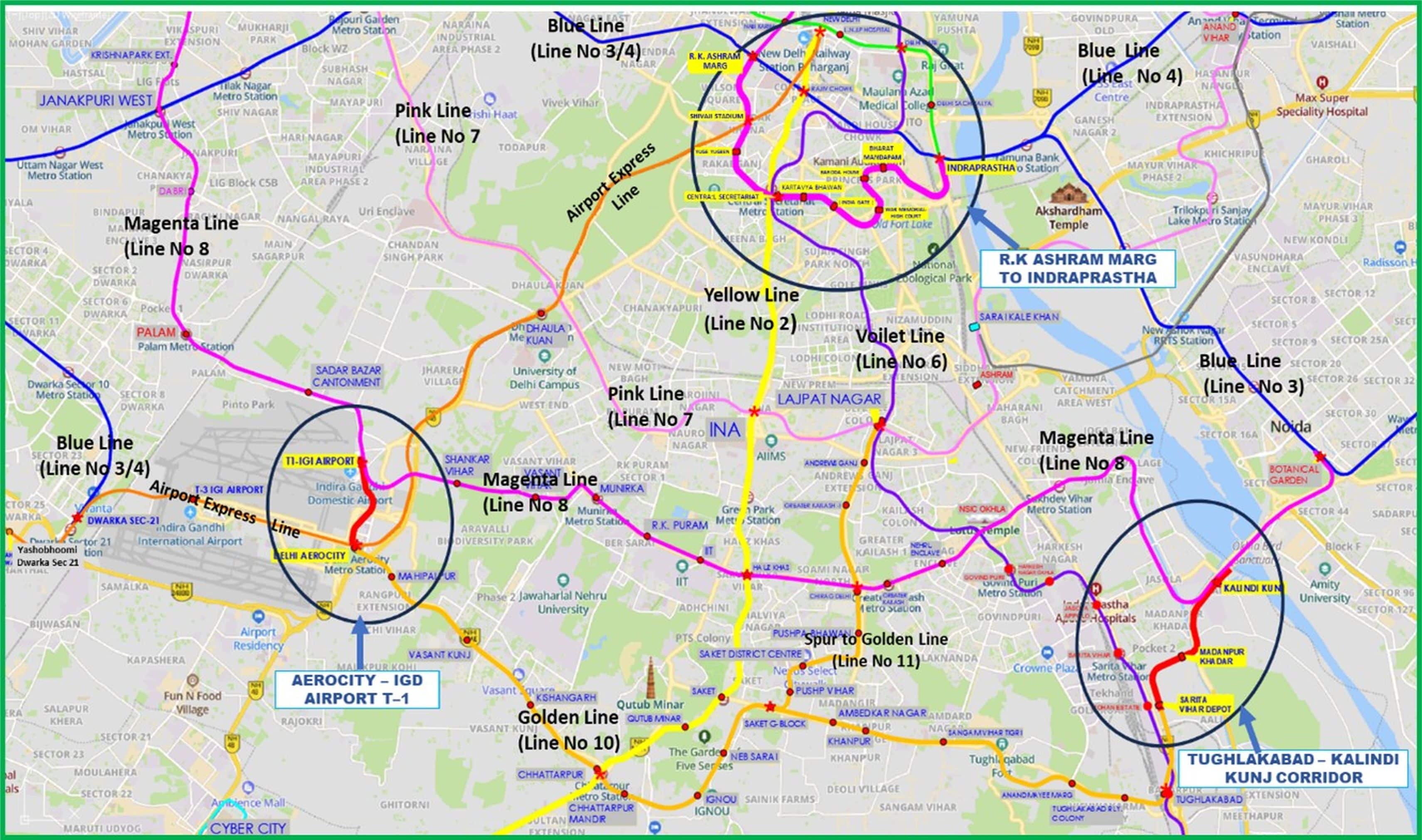
The Union Cabinet chaired by the Prime Minister, Shri Narendra Modi has approved three new corridors - 1. R.K Ashram Marg to Indraprastha (9.913 Kms), 2. Aerocity to IGD Airport T-1 (2.263 kms) 3. Tughlakabad to Kalindi Kunj (3.9 kms) as part of Delhi Metro’s Phase – V(A) project consisting of 16.076 kms which will further enhance connectivity within the national capital. Total project cost of Delhi Metro’s Phase – V(A) project is Rs.12014.91 crore, which will be sourced from Government of India, Government of Delhi, and international funding agencies.

The Central Vista corridor will provide connectivity to all the Kartavya Bhawans thereby providing door step connectivity to the office goers and visitors in this area. With this connectivity around 60,000 office goers and 2 lakh visitors will get benefitted on daily basis. These corridors will further reduce pollution and usage of fossil fuels enhancing ease of living.

Details:

The RK Ashram Marg – Indraprastha section will be an extension of the Botanical Garden-R.K. Ashram Marg corridor. It will provide Metro connectivity to the Central Vista area, which is currently under redevelopment. The Aerocity – IGD Airport Terminal 1 and Tughlakabad – Kalindi Kunj sections will be an extension of the Aerocity-Tughlakabad corridor and will boost connectivity of the airport with the southern parts of the national capital in areas such as Tughlakabad, Saket, Kalindi Kunj etc. These extensions will comprise of 13 stations. Out of these 10 stations will be underground and 03 stations will be elevated.

After completion, the corridor-1 namely R.K Ashram Marg to Indraprastha (9.913 Kms), will improve the connectivity of West, North and old Delhi with Central Delhi and the other two corridors namely Aerocity to IGD Airport T-1 (2.263 kms) and Tughlakabad to Kalindi Kunj (3.9 kms) corridors will connect south Delhi with the domestic Airport Terminal-1 via Saket, Chattarpur etc which will tremendously boost connectivity within National Capital.

These metro extensions of the Phase – V (A) project will expand the reach of Delhi Metro network in Central Delhi and Domestic Airport thereby further boosting the economy. These extensions of the Magenta Line and Golden Line will reduce congestion on the roads; thus, will help in reducing the pollution caused by motor vehicles.

The stations, which shall come up on the RK Ashram Marg - Indraprastha section are: R.K Ashram Marg, Shivaji Stadium, Central Secretariat, Kartavya Bhawan, India Gate, War Memorial - High Court, Baroda House, Bharat Mandapam, and Indraprastha.

The stations on the Tughlakabad – Kalindi Kunj section will be Sarita Vihar Depot, Madanpur Khadar, and Kalindi Kunj, while the Aerocity station will be connected further with the IGD T-1 station.

Construction of Phase-IV consisting of 111 km and 83 stations are underway, and as of today, about 80.43% of civil construction of Phase-IV (3 Priority) corridors has been completed. The Phase-IV (3 Priority) corridors are likely to be completed in stages by December 2026.

Today, the Delhi Metro caters to an average of 65 lakh passenger journeys per day. The maximum passenger journey recorded so far is 81.87 lakh on August 08, 2025. Delhi Metro has become the lifeline of the city by setting the epitome of excellence in the core parameters of MRTS, i.e. punctuality, reliability, and safety.

A total of 12 metro lines of about 395 km with 289 stations are being operated by DMRC in Delhi and NCR at present. Today, Delhi Metro has the largest Metro network in India and is also one of the largest Metros in the world.