India-Greece Joint Statement

Published By : Admin | August 25, 2023 | 23:11 IST

At the invitation of Prime Minister H.E. Kyriakos Mitsotakis, Prime Minister Shri Narendra Modi paid an official visit to the Hellenic Republic on 25th August 2023.

Prime Minister Mitsotakis and Prime Minister Modi acknowledged that both India and Greece share historical linkages and agreed that at a time when the global order is undergoing unprecedented changes, a reenergised approach to enhancing our bilateral relationship is required.

Both leaders held high level talks in a warm and friendly atmosphere. They noted the ongoing cooperation between the two sides and exchanged views on bilateral, regional and international issues of mutual interest.

As leaders of two ancient sea faring nations with a long-standing maritime outlook, they shared their vision of a free, open and rules-based Mediterranean Sea and Indo-Pacific, in accordance with the law of the sea, in particular the provisions of the UNCLOS, and with full respect for the sovereignty, territorial integrity, and freedom of navigation to the benefit of international peace, stability and security.

Both Leaders noted that the EU and India have largest democratic and free market space in the world, and agreed that deepening EU-India relations would be mutually beneficial and have a positive regional and global impact. The Prime Ministers noted with satisfaction that both Greece and India have shown extraordinary economic resilience, despite the challenges in their respective regions, and have restored domestic economic growth. The two Prime Ministers expressed their strong support for the ongoing India-EU trade and investment negotiations and the early implementation of the India-EU Connectivity Partnership.

Building on the foundation of the long-standing warm and close relationship between their countries and peoples, the two leaders decided to upgrade Greek-Indian bilateral ties to the level of a "Strategic Partnership” and agreed to work to further expand bilateral cooperation in political, security and economic spheres. The two Prime Ministers also decided to take steps to further strengthen people-to-people ties between the two countries. Appreciating the increase in bilateral trade and economic engagement in recent years, the leaders also directed that both sides shall work to double bilateral trade by 2030.

Both leaders reiterated the need for further broadening and deepening bilateral engagements, in the field of defence, shipping, science and technology, cyber space, education, culture, tourism and agriculture. They took note of the signing of the MOU on Cooperation in the field of Agriculture, including the establishment of a Hellenic-Indian Joint Sub-committee on Agriculture for facilitating sectoral cooperation for mutual benefit. Both leaders directed their senior officials to ensure regular dialogue in the areas including political, economic, defence, security and public diplomacy. They also agreed to encourage direct flights between Greece and India.

Taking into account the long-standing cultural exchanges between India and Greece, both leaders welcomed efforts to promote exchanges in all forms of art. They also agreed to encourage joint efforts in preserving and protecting ancient sites, and strengthen cooperation within UNESCO.

Both leaders agreed that an early finalization of a Mobility and Migration Partnership Agreement (MMPA) would be mutually beneficial, facilitating in particular the free movement of workforce between the two countries.

The two leaders strongly condemned terrorism in all its forms and manifestations, whenever, wherever, and by whom-so-ever committed and the use of terrorist proxies for cross-border terrorism.

Prime Minister Modi welcomed Greece into the International Solar Alliance (ISA) and looked forward to Greece’s membership of the Coalition for Disaster Resilient Infrastructure (CDRI).

Welcoming India’s Presidency of the G20 Forum, Prime Minister Mitsotakis expressed confidence that under India’s leadership, the G20 will successfully advance its goals.

Prime Minister Modi thanked Prime Minister Mitsotakis for the gracious hospitality extended by the Government and the people of Greece during the visit. Prime Minister Modi extended an invitation to Prime Minister Mitsotakis to visit India.

Explore More
अयोध्येत श्री राम जन्मभूमी मंदिर ध्वजारोहण उत्सवात पंतप्रधानांनी केलेले भाषण

लोकप्रिय भाषण

अयोध्येत श्री राम जन्मभूमी मंदिर ध्वजारोहण उत्सवात पंतप्रधानांनी केलेले भाषण
Year 2025 brought shift in global trade, focus on economic reforms to keep India on high-growth path: RBI

Media Coverage

Year 2025 brought shift in global trade, focus on economic reforms to keep India on high-growth path: RBI
NM on the go

Nm on the go

Always be the first to hear from the PM. Get the App Now!
...
Cabinet approves three new corridors as part of Delhi Metro’s Phase V (A) Project
December 24, 2025

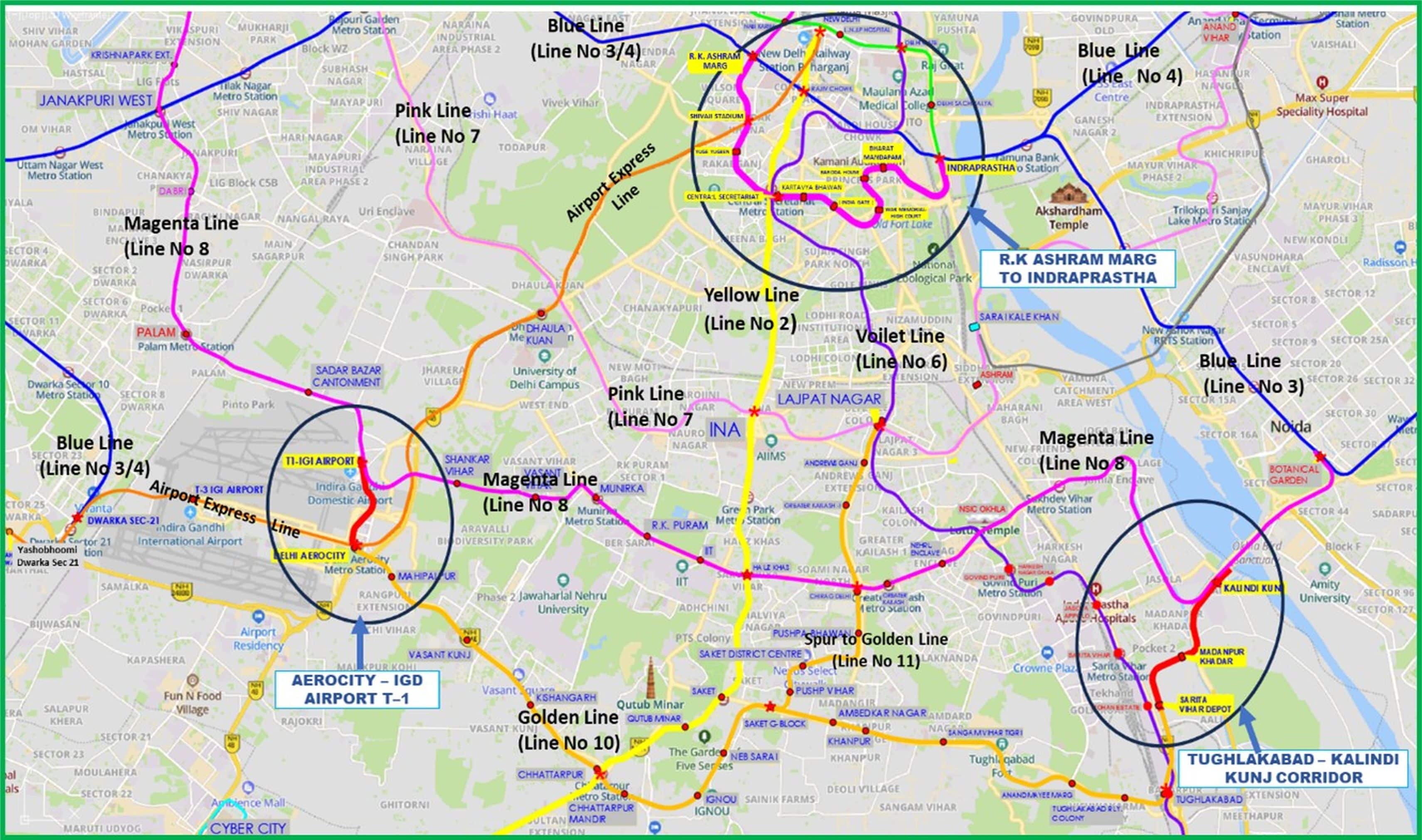
The Union Cabinet chaired by the Prime Minister, Shri Narendra Modi has approved three new corridors - 1. R.K Ashram Marg to Indraprastha (9.913 Kms), 2. Aerocity to IGD Airport T-1 (2.263 kms) 3. Tughlakabad to Kalindi Kunj (3.9 kms) as part of Delhi Metro’s Phase – V(A) project consisting of 16.076 kms which will further enhance connectivity within the national capital. Total project cost of Delhi Metro’s Phase – V(A) project is Rs.12014.91 crore, which will be sourced from Government of India, Government of Delhi, and international funding agencies.

The Central Vista corridor will provide connectivity to all the Kartavya Bhawans thereby providing door step connectivity to the office goers and visitors in this area. With this connectivity around 60,000 office goers and 2 lakh visitors will get benefitted on daily basis. These corridors will further reduce pollution and usage of fossil fuels enhancing ease of living.

Details:

The RK Ashram Marg – Indraprastha section will be an extension of the Botanical Garden-R.K. Ashram Marg corridor. It will provide Metro connectivity to the Central Vista area, which is currently under redevelopment. The Aerocity – IGD Airport Terminal 1 and Tughlakabad – Kalindi Kunj sections will be an extension of the Aerocity-Tughlakabad corridor and will boost connectivity of the airport with the southern parts of the national capital in areas such as Tughlakabad, Saket, Kalindi Kunj etc. These extensions will comprise of 13 stations. Out of these 10 stations will be underground and 03 stations will be elevated.

After completion, the corridor-1 namely R.K Ashram Marg to Indraprastha (9.913 Kms), will improve the connectivity of West, North and old Delhi with Central Delhi and the other two corridors namely Aerocity to IGD Airport T-1 (2.263 kms) and Tughlakabad to Kalindi Kunj (3.9 kms) corridors will connect south Delhi with the domestic Airport Terminal-1 via Saket, Chattarpur etc which will tremendously boost connectivity within National Capital.

These metro extensions of the Phase – V (A) project will expand the reach of Delhi Metro network in Central Delhi and Domestic Airport thereby further boosting the economy. These extensions of the Magenta Line and Golden Line will reduce congestion on the roads; thus, will help in reducing the pollution caused by motor vehicles.

The stations, which shall come up on the RK Ashram Marg - Indraprastha section are: R.K Ashram Marg, Shivaji Stadium, Central Secretariat, Kartavya Bhawan, India Gate, War Memorial - High Court, Baroda House, Bharat Mandapam, and Indraprastha.

The stations on the Tughlakabad – Kalindi Kunj section will be Sarita Vihar Depot, Madanpur Khadar, and Kalindi Kunj, while the Aerocity station will be connected further with the IGD T-1 station.

Construction of Phase-IV consisting of 111 km and 83 stations are underway, and as of today, about 80.43% of civil construction of Phase-IV (3 Priority) corridors has been completed. The Phase-IV (3 Priority) corridors are likely to be completed in stages by December 2026.

Today, the Delhi Metro caters to an average of 65 lakh passenger journeys per day. The maximum passenger journey recorded so far is 81.87 lakh on August 08, 2025. Delhi Metro has become the lifeline of the city by setting the epitome of excellence in the core parameters of MRTS, i.e. punctuality, reliability, and safety.

A total of 12 metro lines of about 395 km with 289 stations are being operated by DMRC in Delhi and NCR at present. Today, Delhi Metro has the largest Metro network in India and is also one of the largest Metros in the world.