List of Outcomes: State Visit of Prime Minister to Saudi Arabia

Published By : Admin | April 23, 2025 | 02:25 IST

I. Strategic Partnership Council

  • The second leaders meeting of the India-Saudi Arabia Strategic Partnership Council (SPC) was co-chaired by Hon’ble Prime Minister of India Shri Narendra Modi and His Royal Highness Prince Mohammed bin Salman, Crown Prince and Prime Minister of the Kingdom of Saudi Arabia on 22 April 2025 in Jeddah. The Council reviewed the work of the various committees, subcommittees and working groups under the SPC, which encompass political, defence, security, trade, investment, energy, technology, agriculture, culture and people-to-people ties. The discussions were followed by signing of the minutes by the two leaders.
  • To reflect the deepening of defence partnership over the past few years – including joint exercises, training programmes, and collaboration in defence industry, the Council decided to create a new Ministerial Committee on Defence Cooperation under the SPC.
  • To strengthen cultural and people-to-people ties, which has significant momentum in recent years, the Council decided to create a new Ministerial Committee on Tourism and Cultural Cooperation under the SPC.
  • The four committees under the India-Saudi Arabia SPC shall now be as follows:

(1) Political, Consular and Security Cooperation Committee.

(2) Defence Cooperation Committee.

(3) Economy, Energy, Investment and Technology Committee.

(4) Tourism and Cultural Cooperation Committee.


II. High Level Task Force on Investment (HLTF)

  • Building on the commitment of Saudi Arabia to invest USD 100 billion in India in multiple areas including energy, petrochemicals, infrastructure, technology, fintech, digital infrastructure, telecommunications, pharmaceuticals, manufacturing and health, the joint High-Level Task Force on Investment came to an understanding in multiple areas to rapidly promote such investment flows.
  • Both sides agreed to collaborate on establishing two refineries in India.
  • The progress made by HLTF in areas such as taxation is a major breakthrough for greater investment cooperation in the future.


III. List of MoUs/Agreements:

  • MoU between the Saudi Space Agency and the Department of Space of India on Cooperation in the field of Space Activities for Peaceful Purposes.
  • MoU between the Ministry of Health of Saudi Arabia and the Ministry of Health and Family Welfare of India on Cooperation in the field of Health.
  • MoU between the Saudi Arabian Anti-Doping Committee (SAADC) and the National Anti-Doping Agency, India (NADA) on Cooperation in the field of Anti-Doping Education and Prevention.
  • Agreement between the Saudi Post Corporation (SPL) and the Department of Posts, Ministry of Communications of India on Cooperation in Inward Surface Parcel.
Explore More
Today, the entire country and entire world is filled with the spirit of Bhagwan Shri Ram: PM Modi at Dhwajarohan Utsav in Ayodhya

Popular Speeches

Today, the entire country and entire world is filled with the spirit of Bhagwan Shri Ram: PM Modi at Dhwajarohan Utsav in Ayodhya
Regional languages take precedence in Lok Sabha addresses

Media Coverage

Regional languages take precedence in Lok Sabha addresses
NM on the go

Nm on the go

Always be the first to hear from the PM. Get the App Now!
...
Cabinet approves three new corridors as part of Delhi Metro’s Phase V (A) Project
December 24, 2025

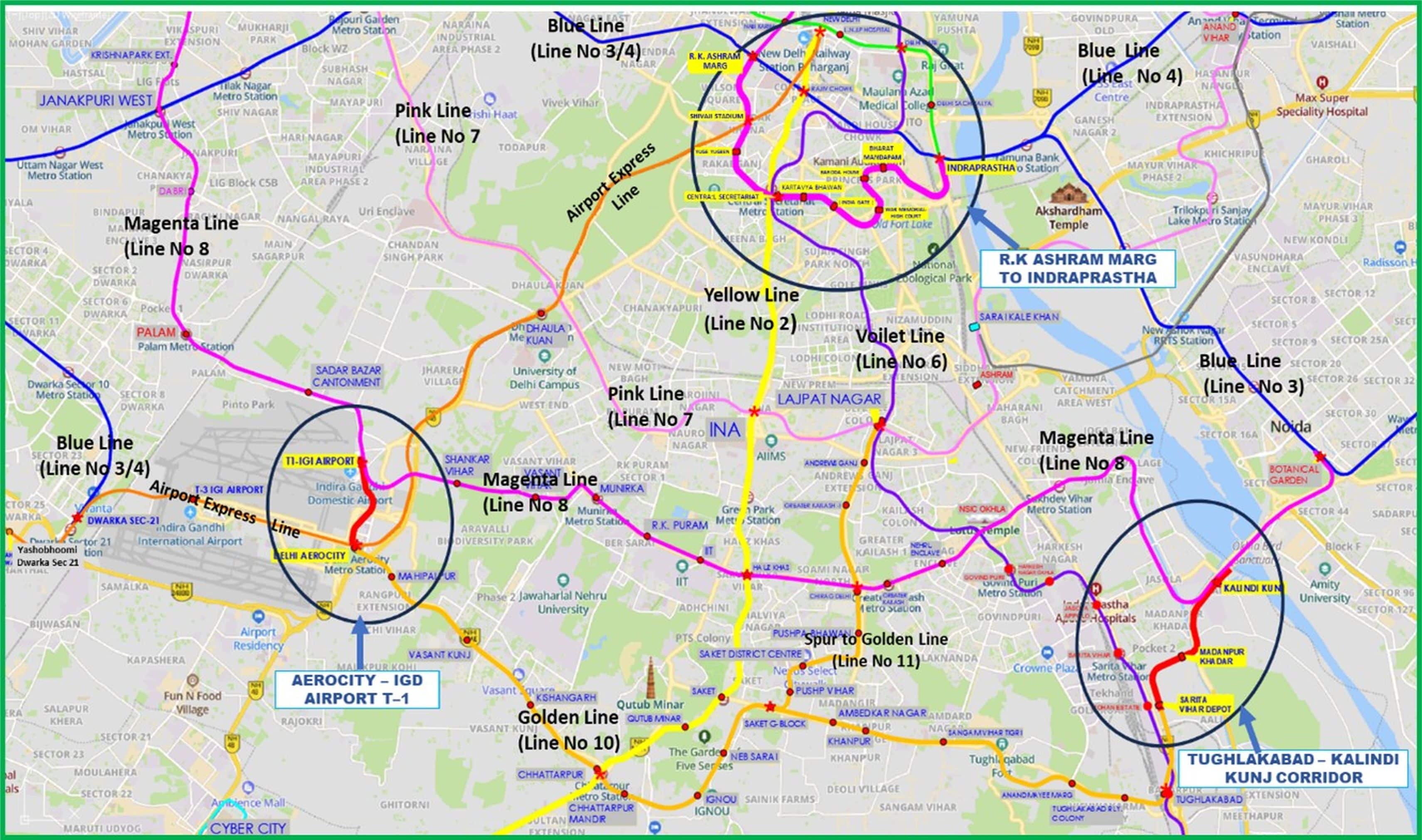
The Union Cabinet chaired by the Prime Minister, Shri Narendra Modi has approved three new corridors - 1. R.K Ashram Marg to Indraprastha (9.913 Kms), 2. Aerocity to IGD Airport T-1 (2.263 kms) 3. Tughlakabad to Kalindi Kunj (3.9 kms) as part of Delhi Metro’s Phase – V(A) project consisting of 16.076 kms which will further enhance connectivity within the national capital. Total project cost of Delhi Metro’s Phase – V(A) project is Rs.12014.91 crore, which will be sourced from Government of India, Government of Delhi, and international funding agencies.

The Central Vista corridor will provide connectivity to all the Kartavya Bhawans thereby providing door step connectivity to the office goers and visitors in this area. With this connectivity around 60,000 office goers and 2 lakh visitors will get benefitted on daily basis. These corridors will further reduce pollution and usage of fossil fuels enhancing ease of living.

Details:

The RK Ashram Marg – Indraprastha section will be an extension of the Botanical Garden-R.K. Ashram Marg corridor. It will provide Metro connectivity to the Central Vista area, which is currently under redevelopment. The Aerocity – IGD Airport Terminal 1 and Tughlakabad – Kalindi Kunj sections will be an extension of the Aerocity-Tughlakabad corridor and will boost connectivity of the airport with the southern parts of the national capital in areas such as Tughlakabad, Saket, Kalindi Kunj etc. These extensions will comprise of 13 stations. Out of these 10 stations will be underground and 03 stations will be elevated.

After completion, the corridor-1 namely R.K Ashram Marg to Indraprastha (9.913 Kms), will improve the connectivity of West, North and old Delhi with Central Delhi and the other two corridors namely Aerocity to IGD Airport T-1 (2.263 kms) and Tughlakabad to Kalindi Kunj (3.9 kms) corridors will connect south Delhi with the domestic Airport Terminal-1 via Saket, Chattarpur etc which will tremendously boost connectivity within National Capital.

These metro extensions of the Phase – V (A) project will expand the reach of Delhi Metro network in Central Delhi and Domestic Airport thereby further boosting the economy. These extensions of the Magenta Line and Golden Line will reduce congestion on the roads; thus, will help in reducing the pollution caused by motor vehicles.

The stations, which shall come up on the RK Ashram Marg - Indraprastha section are: R.K Ashram Marg, Shivaji Stadium, Central Secretariat, Kartavya Bhawan, India Gate, War Memorial - High Court, Baroda House, Bharat Mandapam, and Indraprastha.

The stations on the Tughlakabad – Kalindi Kunj section will be Sarita Vihar Depot, Madanpur Khadar, and Kalindi Kunj, while the Aerocity station will be connected further with the IGD T-1 station.

Construction of Phase-IV consisting of 111 km and 83 stations are underway, and as of today, about 80.43% of civil construction of Phase-IV (3 Priority) corridors has been completed. The Phase-IV (3 Priority) corridors are likely to be completed in stages by December 2026.

Today, the Delhi Metro caters to an average of 65 lakh passenger journeys per day. The maximum passenger journey recorded so far is 81.87 lakh on August 08, 2025. Delhi Metro has become the lifeline of the city by setting the epitome of excellence in the core parameters of MRTS, i.e. punctuality, reliability, and safety.

A total of 12 metro lines of about 395 km with 289 stations are being operated by DMRC in Delhi and NCR at present. Today, Delhi Metro has the largest Metro network in India and is also one of the largest Metros in the world.